GEO INSIGHT

SUMMITFEED Website GEO Before-and-After Report: Comparing JSON-LD Implementation

We compare the code before and after applying JSON-LD on the SUMMITFEED website with Git history and current operating code, and explain the structure of Organization·WebSite·WebPage·Service·FAQPage.

Published July 28, 2026Publisher: SUMMITFEED
This report is a comparison of the Git history of repository SUMMITFEED and the current operational code as of July 24, 2026. Applying structured data helps search systems understand your page, but does not guarantee search rankings, AI citations, or recommendations.

Quick answer

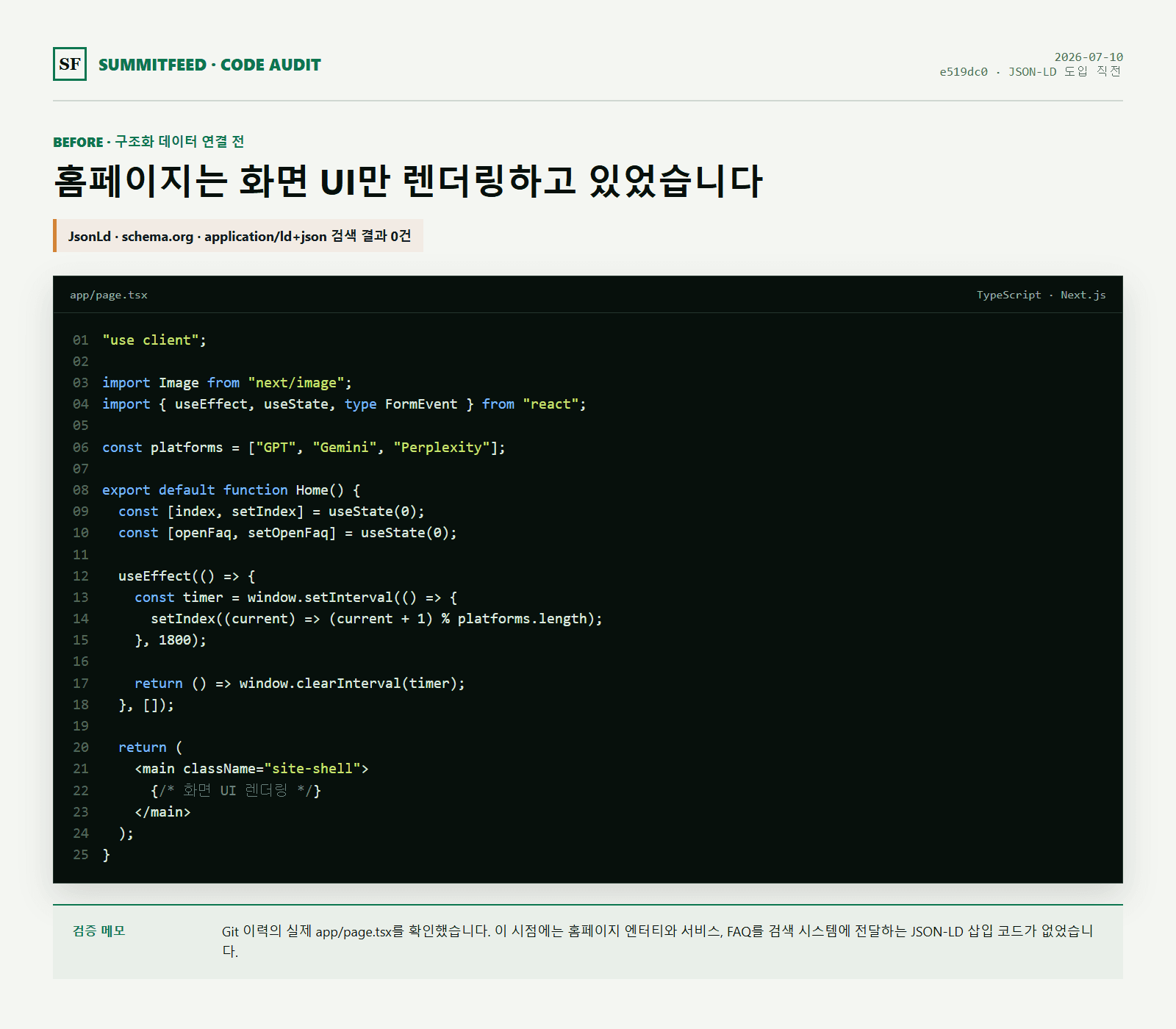
Before the change, the website rendered the screen UI, but there was no JSON-LD insert code to describe the website entities.

The current code concatenates Organization, WebSite, WebPage, BreadcrumbList, Service, and FAQPage with the absolute path ID and actual screen data.

The before-and-after comparison was not an estimate, but was based on the app/page.tsx and current main code in the Git commit, and only publicly available code was included in the capture.

The key change is not to increase the number of schemas, but to change the relationship between brand, site, page, service, and FAQ to convey it consistently in the initial HTML.

Before change

JsonLd, schema.org, application/ld+json connection code 0

After change

Prints 6 types of Schema.org as JSON-LD on website

Verification criteria

Comparison of actual files in Git history and current operating main code

Interpretation Principles

This is to strengthen the basis for understanding the site and does not guarantee exposure or citation performance.

Report scope and comparison criteria

This report records the differences between the operating code before and now the GEO related structured data is linked to the SUMMITFEED website. The comparison target is app/page.tsx in the repository, the baseline before the change is commit e519dc0 on July 10, 2026, just before the introduction of JSON-LD, and the baseline after the change is main commit c2cf075 on July 24, 2026.

We distinguished between confirmed facts and interpretation. What we have confirmed is the import, Schema.org type, @id, URL, and rendering code that exist in each point-in-time file. Since the weighting of this structure by search engines or generative AI is not disclosed, it cannot be assumed to be the direct cause of a specific ranking or citation result.

Before and after comparison evidence
categoryreference pointcheck fileHow to check
Before change2026-07-10 · e519dc0app/page.tsxJsonLd·schema.org·application/ld+json Check absence of string and insertion code
After change2026-07-24 · c2cf075app/page.tsxCheck the current JSON-LD array and JsonLd component insertion code

The commit hash is a reproducible basis for comparison; subsequent changes to the code may differ from the current state.

Before change: There was screen UI, but no website entity descriptions.

Before the change, app/page.tsx had a structure that started with use client and directly managed the screen status and interactions. There was a function to display the screen, but the connection that outputs the relationship between the official company, site, page, service, and FAQ as JSON-LD was not confirmed.

This condition should not be interpreted directly as not crawlable. Plain HTML text and links may be collected separately. However, this means that there was no explicit entity graph that allowed the machine to interpret which organization's official information was the information appearing on the page and which service it was connected to.

Capture of SUMMITFEED website app page code before applying JSON-LD
Excerpt of actual Git code before changes. There were 0 search results for JsonLd, schema.org, application/ld+json.

After change 1: Organization and WebSite were connected by absolute path ID.

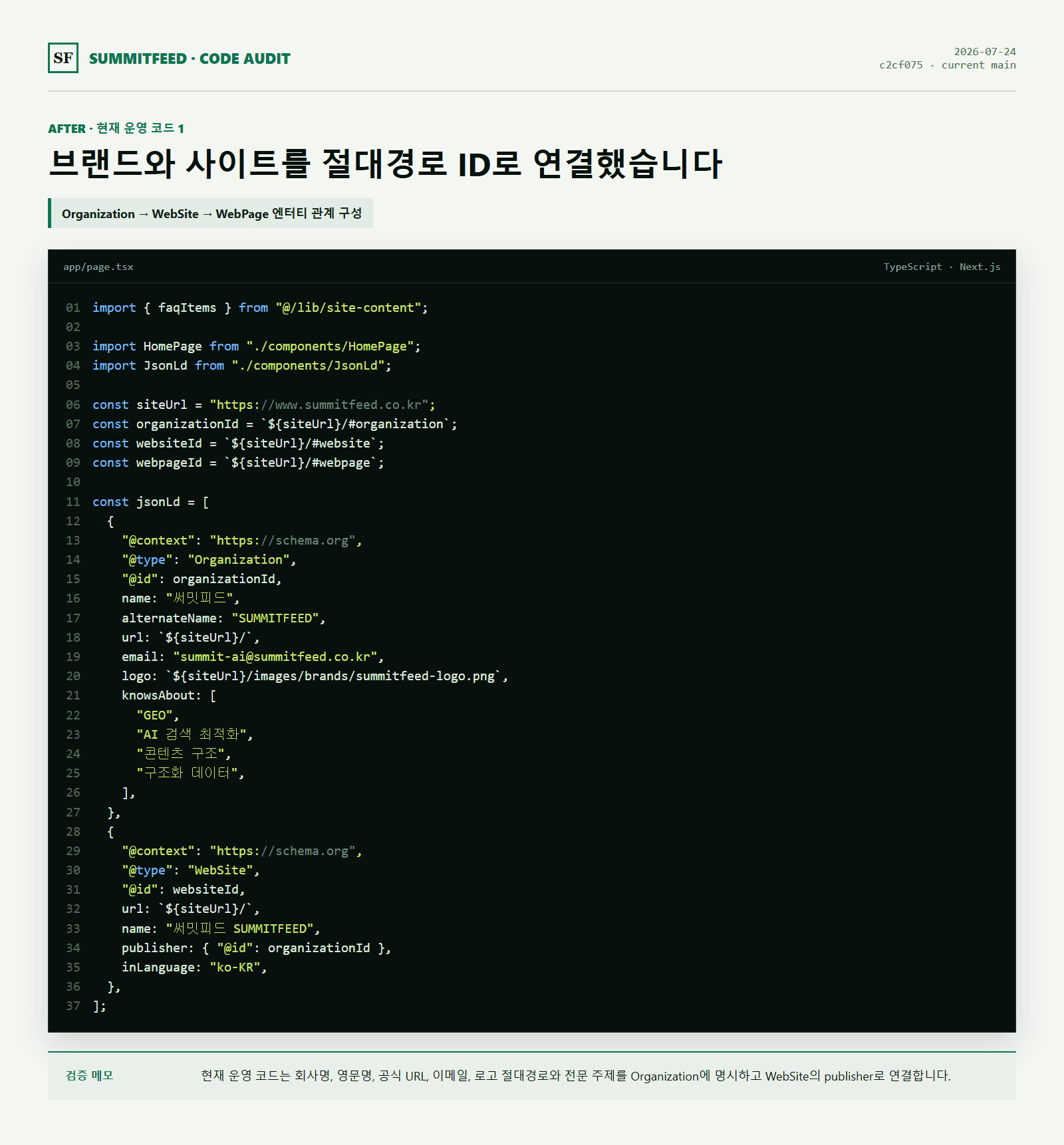
The current code creates unique @ids for organization, website, and webpage based on https://www.summitfeed.co.kr. Organization specifies SUMMITFEED and SUMMITFEED notation, official URL, inquiry email, logo absolute path, and main professional topic.

WebSite connects publisher to organizationId. Instead of writing the same company name or URL repeatedly in multiple schemas, you can use @id to reference a single organizational entity, allowing you to express your brand's relationship with your site more consistently.

Currently capturing codes SUMMITFEED Organization and WebSite JSON-LD
Current operating code 1. Link the official information of Organization and publisher relationship WebSite by absolute path ID.

After change 2: Insert WebPage·Service·FAQPage into the initial HTML

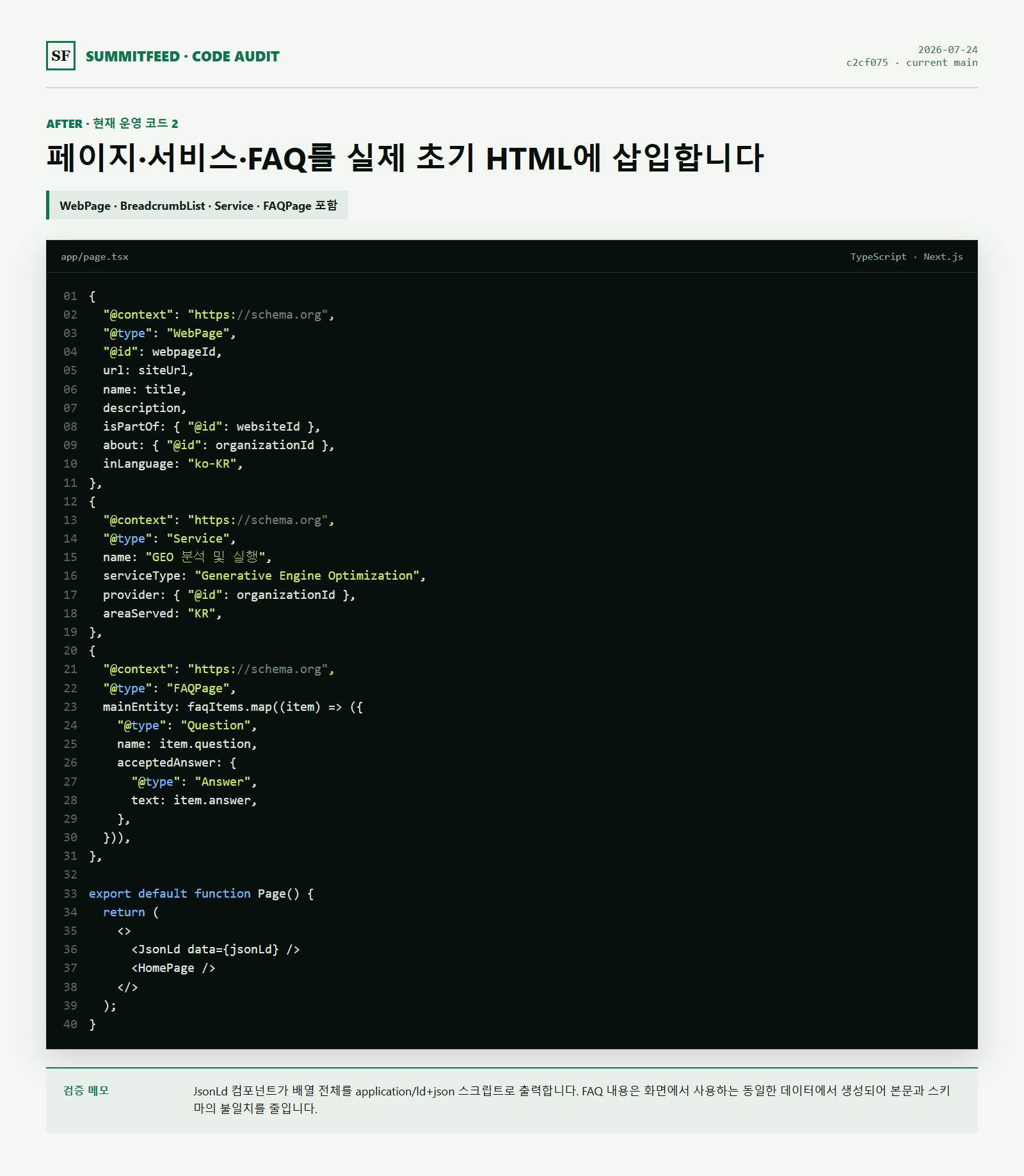
WebPage references WebSite by isPartOf and Organization by about. The Service connects the provider of GEO analysis and execution to the same Organization, and FAQPage generates questions and answers from faqItems displayed on the website screen.

The JsonLd component outputs this array to the application/ld+json script. Structured data can be read independently of whether JavaScript is running or not, as it is configured to be checked in the initial HTML returned by the server rather than in the values ​​it creates after waiting for client interaction.

Current SUMMITFEED WebPage Service FAQPage and JsonLd injection code capture
Current operating code 2. You can check the page·service·FAQ schema and the actual JsonLd insertion point together.

6 schemas and roles currently applied to the website

The current website uses 6 types: Schema.org. Having a lot of types is not the goal in itself. The key is to express only information that actually exists on the screen and connect the relationships between organizations and websites, pages and services using the same @id system.

SUMMITFEED website JSON-LD composition
Type Schema.orgInformation currently expressedcomplementary relationship
OrganizationCompany name, English name, official URL, email, logo, professional topicAnother schema references #organization
WebSiteOfficial website name, URL, languagepublisher refers to Organization
WebPagewebsite title, description, languageisPartOf refers to WebSite, about refers to Organization
BreadcrumbListHome location of current pageRepresent home URL as a list item
ServiceGEO Analysis and Execution Services and Areas Servedprovider refers to Organization
FAQPageQuestions and answers displayed on the websiteUse the same faqItems data as your screen

Structured data must be kept consistent with what users can actually see on screen.

What has changed from GEO perspective

Before the change, the brand name and service description existed only in screen context. After the change, the relationship between the official organization, site, website, and service was clearly expressed, and the company name and logo URL were also unified under one standard.

This structure is the foundation that search systems and AI-based collection systems can use to interpret the subject and topic of a page. However, adding JSON-LD alone does not automatically improve the accuracy of your content, external sources, site reputation, crawlability status, or question relevance.

Therefore, in GEO operation, robots.txt, sitemap.xml, canonical, internal links, screen body, author, publication and modification dates, and external sources must be checked along with structured data. After application, actual search results and changes in mentions and citations for each question must be measured separately.

Difference between simple insert and operational structure
Check itemsApply codeAdditional information to check in operations
brand entityLink Organization and official URLCompany name, logo, and contact information match throughout the site
content meaningExpression WebPage·Service·FAQPageMatch screen body and schema content
collection pathPrint JSON-LD in initial HTMLCheck robots.txt·canonical·sitemap·status code
performance judgmentSchema validationSeparately measure exposure, mention, citation, and recommendation by question

Pre-publication verification checklist

Structured data does more than just verify that code exists. You must also check the initial HTML of the final operational URL, matching schema values ​​and screen content, absolute path asset accessibility, and duplicate entities.

JSON-LD public verification items
Check itemsHow to checkBased on current report
Includes initial HTMLCheck application/ld+json in page sourceCheck JsonLd component insertion code
Official URLCheck whether url·@id·logo is an absolute https pathsummitfeed.co.kr Use absolute path
Match screen and schemaCompare company name, service, and FAQ with screenFAQs use the same faqItems data
Entity AssociationCheck @id of publisher·about·providerSee #organization and #website
Performance interpretationSeparate structure application and exposure performanceDo not use ranking/AI citation guarantee expressions

JSON-LD Operation Checklist

  • Make sure the company name, English name, official URL, email and logo are consistent throughout the site.
  • Check whether the URL including the logo and canonical is an absolute https path.
  • Ensure that services and FAQs in structured data are present in the actual screen body
  • Use @id to check whether the relationships Organization, WebSite, and WebPage are not broken.
  • After operational deployment, check the page source to see if application/ld+json is included in the initial HTML
  • Do not express JSON-LD application as search ranking or AI citation guarantee

Frequently asked questions

If I enter JSON-LD, will it be cited directly in AI search?

no. JSON-LD is a foundation that helps interpret the entities and relationships on the page. Actual mentions or citations depend on a number of conditions, including suitability of the question, quality of the text, collectability, reliability of the source, timing and platform, etc.

Were search engines unable to read the website at all before the change?

You can't be so sure. Plain HTML body and links could be collected. The difference identified in this report is the presence or absence of an explicit JSON-LD link code that describes the website entity.

Why do I write the company name and logo URL as absolute paths?

This is to clearly express the location of official organizations and assets in one address system, and to refer to the same entity regardless of page location.

FAQPage Can I add questions that are not on the screen?

It's safer to base your questions and answers on the actual questions and answers users can see on the screen. The SUMMITFEED website uses the same faqItems data as the screen and JSON-LD.

Is the more schemas the better?

no. You should only use information that actually exists and can be described on the page. Entity relationships, accuracy of values, and consistency with screen content are more important than number of types.

Conclusion: Structuring is the basis of GEO's operations, not a performance guarantee device

The biggest change in the SUMMITFEED website is not the number of schemas (from 0 to 6). Official organizations, websites, homepages, services and FAQs are linked by a single URL and @id system and can be read from early HTML.

This structure communicates your brand and page meaning more clearly, but by itself does not guarantee search rankings or generative AI citations. It must be managed together with accurate text, consistent brand information, collectible technical structures, external sources and repeatable measurements.

SUMMITFEED operates the GEO structure by not only checking whether or not the code is applied, but also checking the consistency of screen information and schema, collection path, and changes in exposure for each question.

Request a GEO audit

Tags

#GEO#JSON-LD#structured data#Schema#HomepageGEO#Technology report

Continue reading

Sources and references

  1. Schema.org Organization
  2. Schema.org WebSite
  3. Schema.org FAQPage
  4. Introduction to Google Search Central Structured Data
This article is a technical report written by directly comparing the Git history of the SUMMITFEED website repository and the current operating code.

Search results and generated AI answers may vary depending on platform, question, timing, and user conditions, and do not guarantee specific exposure, ranking, or citations.